What a powered gate does to the metal
Every cycle sends a small load through the welds, rails, and wrought-iron pieces in the assembly. Over time that load finds the weakest line. You'll see a rail that no longer sits flush, a joint that looks thinner on one side, or a section that flexes more than its neighbors. It rarely fails all at once.
We check the finished shape and the dimensions to decide whether the existing metal can be brought back within tolerance or a railing section has to be replaced. That decision also sets the scope: replacement railing is priced as a measured run of installed wrought iron, not as a vague patch.
Before welding starts on-site
We treat the area around the gate as a hot-work zone. Combustibles nearby get removed or shielded, a suitable fire extinguisher stays within reach, and we post a fire watch when one is required. The extinguisher doesn't get buried under the railing pieces we've pulled off.
Then we lay out the repair before any heat goes in. A scriber marks the line, and welding clamps hold the pieces in position while we check the fit. If the alignment is off while the metal is cold, it will be off after the weld cools too.
Weather figures into the schedule. Grove City gets about 41.6 inches of rain a year, mostly in June and July, with July the wettest at around 4.7 inches. February is the driest, at about 2.4. In the wet months we'd rather move a welding day than weld in the rain.
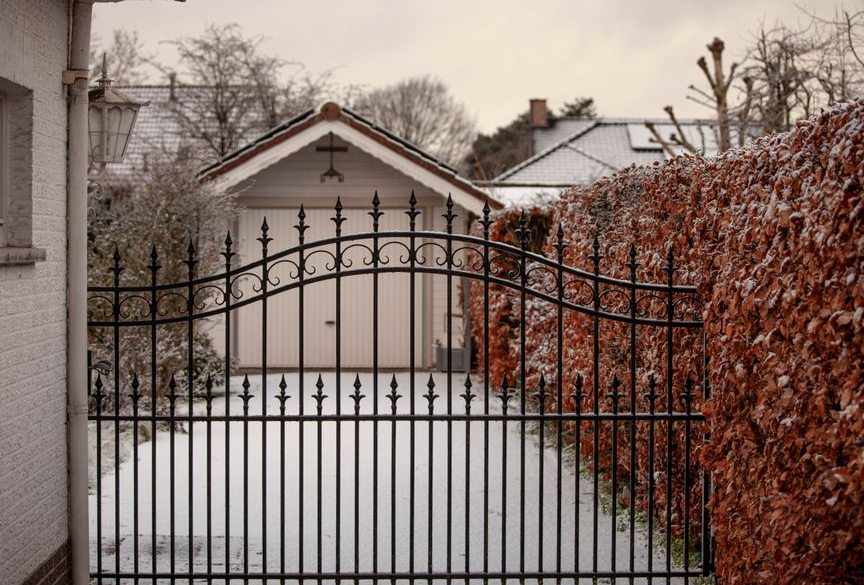
Checking the work after the weld
When the weld is done, we visually check that it's complete and measure its dimensions. Then we check the finished construction's shape and tolerances. On a powered gate, that means confirming the repaired section still lines up with the moving parts around it.
If a rail sits proud, a joint came out short, or the frame has pulled out of square, we correct it before the gate goes back into service. Skipping this step is how a repair turns into a callback.
What the railing portion costs
If a section of wrought-iron railing can't be saved, installed replacement runs $65 to $135 per linear foot. That's the price for railing in place, not for loose material.
The final number depends on how many linear feet we replace and how much of the existing railing the repair has to tie into. We measure the run, mark it, and set the scope before we start, so the quote is built on actual installed length.
Inside the Job
A visual look at what the service involves.

Our Process
-
Tell Us What's Going On
A two-minute call is enough to tell us what we're working with and what to check first.
-
On-Site Inspection
We come out, measure what's actually happening, and walk you through what we find.
-
Know the Price First
We put the fix, the timeline, and the number on paper — take your time with it.
In practice, on a job like this:
- Grind the completed weld and sand the surface smooth, taking care not to overheat thin metal.
- After welding, visually check weld completeness and dimensions, and check the finished construction's shape and tolerances.
What to Expect to Pay
These are planning ranges. Nothing is final until it is in writing.
$150–$350
$400–$1200
Communities We Cover
We cover Grove City, OH. Call (380) 979-0282 to confirm coverage for your address.
More Ways We Can Help
How We Do Business
Need help today? Call (380) 979-0282.